The hidden cost of batteries: Why zero-maintenance access is a smarter long-term investment

When organizations evaluate smart-locking solutions, they often focus on purchase price, security features and ease of installation. Far less attention is paid to what happens after deployment.
For housing providers, utility operators and critical-infrastructure owners, the real costs of an access-management system are often measured over years of operation, not at the point of purchase. This is where battery-free smart access creates a fundamentally different value proposition.
The question is no longer simply: How much does a lock cost? It is: How much time, money and effort will it take to keep that lock working throughout its lifetime?
The maintenance problem nobody budgets for
A battery-powered smart lock may only require a battery change once every few years. That sounds insignificant until the numbers are multiplied across an entire portfolio. Consider a residential property with 500 access points. If every lock requires battery inspections, replacement visits and administrative tracking, maintenance quickly becomes a recurring operational task. Multiply that across a housing portfolio, utility network or telecom infrastructure comprising thousands of doors, cabinets and gates, and the workload becomes substantial.
The direct cost is only part of the story. Organizations must also account for:
- Technician travel time
- Labor costs
- Maintenance scheduling
- Replacement battery purchases
- Inventory management
- Disposal and recycling requirements
- Operational disruption
Many organizations discover that the hidden costs surrounding batteries ultimately exceed the cost of the batteries themselves.
Quantifying the impact
Let’s assume a utility operator manages 5,000 remote access points. If each lock requires a battery replacement visit every few years and each visit consumes just one hour of technician time, travel and administration included, the organization quickly faces thousands of maintenance hours over the lifetime of the system. For critical infrastructure sites, the impact can be even greater. A technician may need to travel considerable distances to reach a remote telecom tower, electrical substation or water-treatment facility. In these situations, replacing a battery becomes far more expensive than the battery itself. The result is a continuous maintenance cycle that consumes resources without delivering additional operational value.
A different approach: Zero batteries
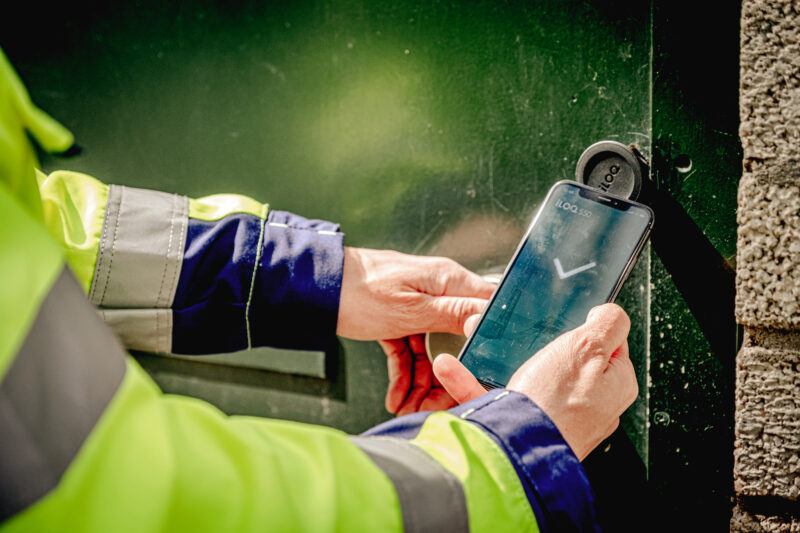
This is where iLOQ takes a fundamentally different approach. Instead of storing energy inside the lock, iLOQ’s technology generates the energy needed for unlocking at the moment access is requested. In the iLOQ S5 system, energy is harvested from the motion of inserting the digital key. In the iLOQ S50 system, energy is harvested from the NFC field of a compatible smartphone or iLOQ key fob.
The result is simple:
- No batteries inside the lock
- No battery replacement programs
- No battery disposal
- No battery-related lock failures
For administrators, this dramatically reduces maintenance requirements while improving long-term reliability.
Impact on residential properties
Residential properties and multifamily housing communities often experience constant changes in occupancy. Residents move in and out. Contractors require access. Common spaces need to be managed. At the same time, maintenance teams are under pressure to control costs and improve service levels.
When locks require batteries, every access point becomes another asset requiring monitoring and maintenance. Battery-free access removes that burden. Instead of spending time replacing batteries, property teams can focus on resident experience, building improvements and operational priorities. This is particularly valuable for housing providers managing hundreds or thousands of apartments across multiple sites.
Impact on utilities
Utilities face an even greater challenge. Telecom networks, energy companies and water providers often manage thousands of unmanned assets spread across large geographical areas. Every maintenance visit has a cost. A battery-powered lock on a remote telecom tower may eventually require a technician to travel hundreds of kilometers simply to replace batteries and confirm functionality.
Battery-free technology eliminates that requirement entirely. The result is fewer site visits, lower operational costs, increased reliability and greater operational efficiency. For networks containing thousands of sites, the cumulative savings can be significant.
Impact on critical infrastructure
Critical infrastructure operators often prioritize one requirement above all others: Reliability. Access points protecting substations, utilities, transportation assets and communications infrastructure must continue working regardless of weather, temperature or operating conditions. In these environments, batteries introduce an additional point of failure. By eliminating batteries, organizations eliminate an entire category of maintenance and reliability risk.
This is one reason battery-free access has become increasingly attractive for sectors where uptime, resilience and operational continuity are essential.
The bigger advantage: Zero maintenance
The real advantage of battery-free access is not just the absence of batteries. It is the reduction of ongoing maintenance. Every maintenance activity requires resources, whether it is time, people, planning, budget, travel or administration.
When thousands of these activities are removed from an organization’s operating model, the benefits extend far beyond the access-management system itself. Teams become more productive. Operational costs decrease. Service levels improve. And organizations gain confidence that access will be available whenever it is needed.
Looking ahead
The future of smart access will be increasingly digital. Access rights will be managed remotely. Mobile credentials will become commonplace. Infrastructure will become more connected. But as organizations continue to digitalize, a fundamental question will remain: How much maintenance does the technology create?
The smartest access solution is not necessarily the one with the most features. It is the one that delivers security, convenience and control while demanding the least amount of ongoing effort. That is where zero batteries and zero maintenance become powerful differentiators.
For housing providers, utilities and critical-infrastructure operators, the value is clear: fewer site visits, lower lifecycle costs and greater operational resilience. Because the best maintenance task is the one that never needs to happen.
If you’re looking to reduce maintenance costs, eliminate battery-related challenges and improve long-term access reliability, iLOQ’s battery-free smart-access solutions can help. Contact iLOQ to discover how zero batteries and zero maintenance can deliver lasting value across your properties, infrastructure and operations.
Contact us
Contact your local iLOQ team for a free consultation.